Get In Touch
- +918920243588
- info@mistermisting.com
- WZ-8/5 A, Kirti Nagar Industrial Area, New Delhi - 110015, Delhi
Quick Links
Menu

Put simply, it's a setup that stops dust before it has a chance to spread using fine water mist right at the point where dust is being generated. Most sites deal with dust the wrong way: they let it drift, settle on equipment, get kicked up again, and eventually end up in someone's lungs.
A dust suppression system catches it early instead and brings it back down to the ground. People often assume this is the same as just hosing down a site. It's not, and honestly, hosing barely helps—it wastes a lot of water and does almost nothing for the fine particles that cause the real problems.
What actually works is controlled, fine-droplet misting or fogging, built specifically to bind with airborne dust rather than just wetting whatever surface is underneath.
Fine dust particles don't just fall to the ground quickly. They hang in the air for a long time, which creates real problems for health, for visibility, for how smoothly operations run. Regular water spray doesn't help much here either; the droplets are too large and mostly fall straight through the dust cloud without touching it.
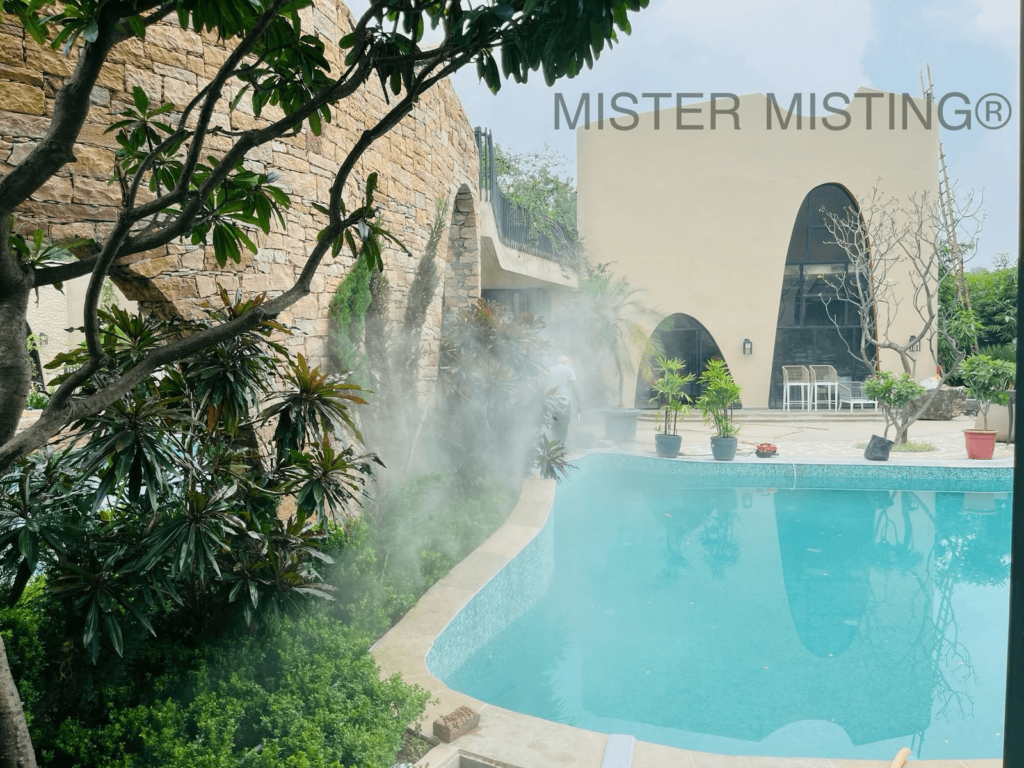
A water mist system gets around this by producing much finer droplets, small enough to actually collide with the dust particles floating in the air. When a droplet meets a dust particle, it clings to it. That added weight is enough to pull the combined particle out of the air. Over time, this noticeably cuts down airborne dust during active operations.
Most systems get built right around the dust source—nozzles placed at a crusher outlet, along a conveyor, around a demolition area, or at a loading and unloading point. Everything connects back to a pump and water supply sized for the coverage the site needs.
At Mister Misting, we build around the actual dust source—a crusher, a conveyor belt, a demolition zone, a loading bay—instead of spraying water generally across a site and hoping something sticks.
We handle everything ourselves—site assessment, design, installation, and the maintenance after that. That means you're working with one team that actually understands your setup.
We've now worked on 600+ projects across industrial, construction, and commercial sites, shaping how we approach each new project effectively.
High-pressure pumps: Built for continuous or intermittent heavy-duty use.
Precision nozzles: Sized specifically for dust suppression, not general-purpose misting.
Corrosion-resistant fittings: Engineered to take harsh site conditions.
Automation: Sensors or timers make it hands-off once installed. It kicks in only when there's actual dust-generating activity.
Scalable coverage: From a single crusher point up to covering an entire site perimeter.
Custom layouts: Built around where the dust is actually coming from and matched to specific installation needs.
Different sites generate different kinds of dust. Here is where our suppression systems make the biggest difference.
Crushers, conveyors, stockpiles, haul roads—all of these throw up serious amounts of dust, and suppression at these exact points is a core part of a site's dust-control approach.
Demolition, excavation, material handling—dust never really stops on a construction site, and when working near residential areas, complaints pile up fast if not managed.
Loading docks and bulk storage areas generate dust that affects both worker health and the condition of stored products. Fine mist traps it before it settles on inventory.
Grinding, cutting, bulk material handling—these processes need real industrial dust suppression, both for working conditions and to stop dust from gumming up equipment.
Structural demolition throws up sudden, heavy dust loads, and suppression here works best when it's designed specifically around the active work zones.
It varies based on the design, nozzles, and area covered. Since the system targets dust right at the source, water gets used in a controlled way instead of just being sprayed everywhere.
Yes, it can be designed for operations that size. Bigger sites usually need multiple dust points covered rather than relying on one central installation.
In most setups, yes. Sensors or timers trigger it when there's dust-generating work happening, so nobody's manually switching it on and off all day.
It can, depending on what your local regulations actually require. Worth getting your site's specific environmental and workplace requirements checked rather than assuming.
Not a lot, generally periodic nozzle cleaning and pump checks cover most of it. Sites dealing with particularly harsh dust or debris might need to check in a bit more often.
Usually, yes. Most installs are planned around whatever's already happening on-site, and we work with your team to keep disruption to a minimum.
Whether it's a mine, a construction site, or a factory floor fighting airborne dust, a properly designed dust suppression system genuinely changes working conditions, keeps equipment cleaner, and makes dust management manageable.
We'll come assess your site, figure out where the dust's actually coming from, and build something around that. Looking for an industrial dust suppression setup or something more customised? We'll help figure out the right approach based on your site conditions.